Three words, in about half the tenancy agreements I see, and not one of them means anything measurable.
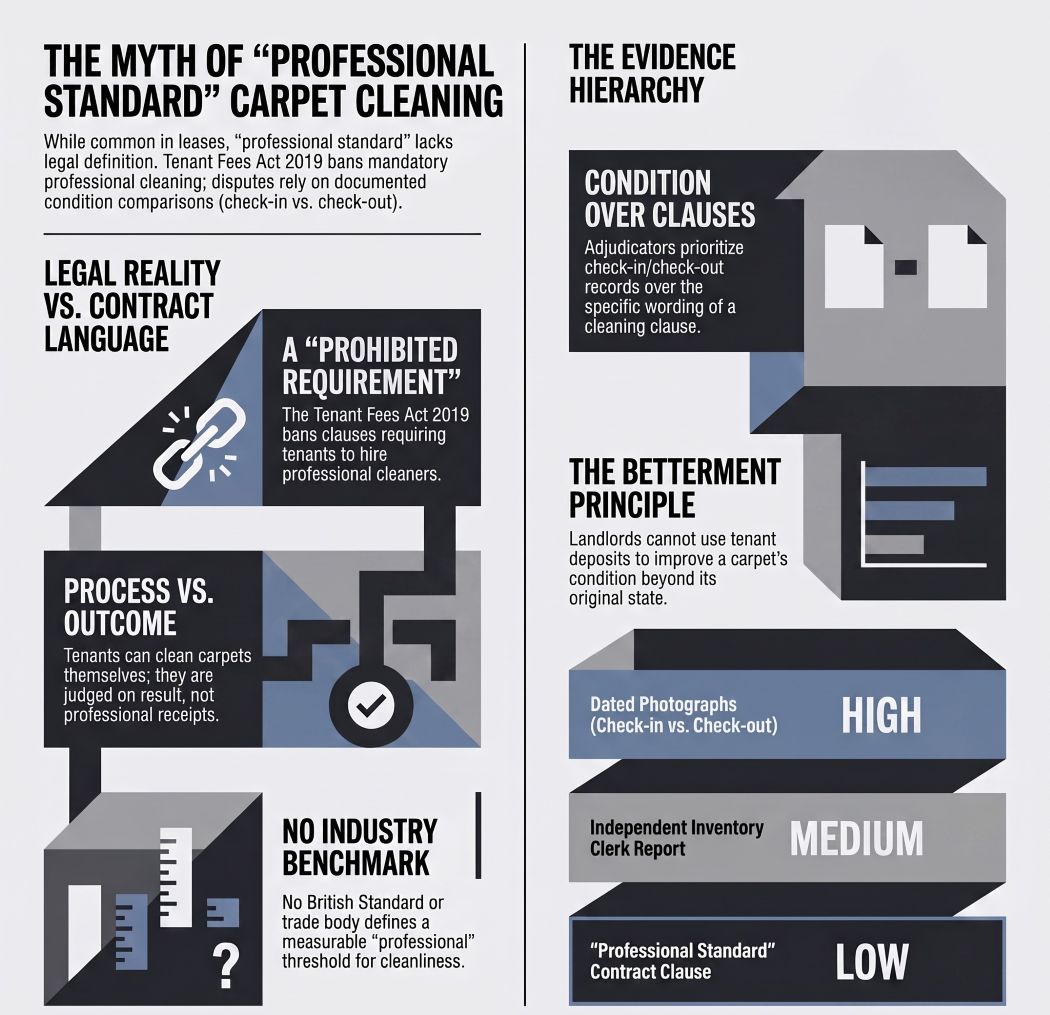
“Cleaned to a professional standard.” It appears in the cleaning schedule of an assured tenancy, it appears in agents’ check-out reports, and it appears on invoices issued by my own trade, mine included, because agents ask for it. There is no such standard. No statute defines it, no British Standard specifies it, no trade body publishes a threshold that a carpet either meets or fails. It is a phrase that has survived because everyone assumes somebody else has defined it.
What does “professional standard” mean in a tenancy agreement?
Something narrower than it looks, and the narrowing is the whole story.
The Tenant Fees Act 2019 banned landlords and agents in England from requiring a tenant to pay a third party as a condition of the tenancy, and end-of-tenancy cleaning sits squarely inside that ban. A clause obliging a tenant to hire a cleaning company, or to produce a receipt proving they did, is a prohibited requirement. It has been unenforceable across effectively all tenancies in England for years now. Wales has its own equivalent.
What survives is the obligation to return the property in the condition recorded at the start, fair wear and tear excepted.
There is one route by which the phrase acquires meaning, and it is worth knowing because it is the only one. If the carpets were professionally cleaned before the tenant moved in, and there is a dated invoice and photographs proving it, then the condition recorded at check-in was the output of a professional clean. The tenant’s obligation is to return the property to that condition. The benchmark has content because somebody documented it, and the words in the clause did no work at all – the paperwork did.
The difference between a process and an outcome
Agents adapted quickly. “Professionally cleaned” is a process requirement and it is dead. “Cleaned to a professional standard” is an outcome requirement, and drafters believe it survives the ban because it describes a result rather than compelling a purchase.
That belief is probably right in law, and it creates the problem this piece is about. The clause that survived is the one nobody can define. A tenant can lawfully do the work themselves with a hired machine from a supermarket forecourt, and they are then judged against an unstated benchmark named after the very professionals they were told they need not hire.
Ask an agent to specify it and you get a description of the outcome using the word in the definition. There is no such standard.
Is there a British Standard for a clean carpet?
No. There is not one for a clean anything, domestically.
The nearest things that exist are process documents. There are standards and codes of practice covering how carpet cleaning is carried out, what a technician should know, and how a business should conduct itself. The NCCA trains and certifies people. Manufacturers publish maintenance recommendations for their own products. None of that produces a measurable state that an inspector could hold a carpet against and mark pass or fail.
What certification does cover
My certification says I have been examined on fibre identification, soil removal and health and safety. It says nothing whatever about the condition in which I leave a given carpet, because that depends on the fibre, the age, the soiling history, whether the previous occupant had a dog, and whether anyone has ever put a silicone-heavy retail spot remover on it. A certified technician working competently on an eleven-year-old polypropylene twist in a Brockley conversion produces a result that would be a failure on a two-year-old wool loop in the same street.
Which is why the phrase does no work. It attaches a fixed label to an outcome that is entirely determined by the starting material.
The trade does have codes of practice, and they matter for different reasons. They set out how to identify a fibre before you wet it, what test to run on a dye before you commit, how to handle a wool rug that has been laid over an underfloor heating manifold. Those documents protect carpets from bad decisions. They were never written to give a letting agent a pass mark, and reading them as though they were is a category error that costs tenants money every week.
What do deposit adjudicators do with the phrase?
Less than landlords expect and more than tenants fear.
Cleaning is the most common category of deposit dispute and has been for as long as the schemes have published figures. When an adjudicator receives a claim, the phrase in the tenancy agreement is close to the bottom of the evidence pile. What decides it is the check-in record against the check-out record. Photographs, dated, of the same areas. A written inventory that says something more useful than “carpets: good”.
Betterment, apportionment and the age of the carpet
Two principles do most of the work and neither is widely understood by the people writing the clauses.
The first is that a landlord cannot be put in a better position than they were in before. A carpet cleaned at check-in and dirty at check-out gets cleaned again at the tenant’s cost. A carpet that was already tired at check-in and is more tired now produces an apportioned award, because the landlord is not entitled to a renewal funded by the outgoing tenant.
The second is the expected lifespan of the item. Adjudicators work to industry lifespans for carpet – a medium-quality carpet in a rental is generally treated as having something under a decade in it – and a claim for full replacement of a carpet that has already run most of that period will be reduced heavily or refused. I gave evidence on a Wickham Road flat in SE4 where the agent claimed the full cost of replacing a bedroom carpet over three cigarette burns. The carpet was nine years old and had been through four tenancies. The award covered a repair and nothing else, and the invoice I had written months earlier for the previous tenant, which said the carpet was already worn at the door threshold and could not be improved further, did more for that outcome than the tenancy agreement did.
There is a hierarchy to what adjudicators find persuasive and it is consistent across the schemes. Dated photographs of the same area at both ends of the tenancy sit at the top. A detailed written inventory prepared by an independent clerk sits below that. An agent’s own check-out report, prepared by a member of staff with an interest in the outcome, sits below that again. The wording of the cleaning clause sits at the bottom, and a tenant who has done the work themselves to a good result will beat a clause every time.
I have also seen the reverse, where a tenant paid a firm three hundred pounds, kept the receipt, and lost, because the carpets were still marked and a receipt is evidence of a transaction rather than of a condition.
An invoice that describes what was found is worth more than one that asserts a standard. There is no such standard, and adjudicators know it.
Has the Renters’ Rights Act changed any of this?
Not the cleaning rules. It has changed the thing that cleaning claims depend on.
Tenancies in England are now assured periodic – rolling, with no fixed end date. The deposit rules themselves carried over largely unchanged, and a landlord can still deduct for cleaning where the property is left worse than it was found. What has shifted is the shape of the tenancy the evidence has to span.
An open-ended tenancy means an ageing baseline
A fixed twelve-month term with a check-in and a check-out is a tidy comparison. A tenancy that rolls for six or seven years is a different exercise. The check-in photographs are old, the carpet has aged past a chunk of its expected life during the tenancy itself, and fair wear and tear over that period is a much larger deduction from any claim. The longer the tenancy runs, the weaker a cleaning-based claim becomes, and interim inspection records start doing work that the original inventory used to do alone.
For landlords, the practical answer is a properly cleaned and documented carpet at the start of every tenancy, and dated records at intervals during it. For tenants in a long tenancy, the arithmetic has quietly moved in your favour and most people have not noticed.
What should be written on the invoice instead?
A description, not a grade.
Here is where I take issue with my own trade. We prop this phrase up. We write “cleaned to a professional standard” on documents because agents ask for it and because it sounds like it means something, and every time we do it we lend authority to a term we cannot define under questioning. It should be struck out of tenancy agreements and off invoices, and the fact that it is convenient is not a defence of it.
What a useful cleaning record contains
Fibre and construction. Rooms and approximate areas. Method used. Pre-existing conditions found, described plainly and photographed – the traffic lane at the hall door, the shading in the bay, the two rings by the sofa that lifted partially and no further. What was removed. What would not come out and the reason. Date and time.
That document is useful to a landlord, to a tenant and to an adjudicator, because it records a state rather than claiming a grade. It also protects me, which I will admit is why I started writing them that way.
A flat off Northfield Avenue in W5 last spring: the agent’s check-out said the carpets “had not been cleaned to a professional standard”. They had been cleaned by me, eight days earlier, with photographs. The deduction did not survive.
Editorial flags
- Legal content throughout. Confirm with a housing solicitor before publication, particularly the process-versus-outcome distinction, which is a widely held reading rather than a tested one.
- Tenant Fees Act 2019 commencement dates (1 June 2019 and 1 June 2020) have been kept out of the body copy. Add only if you plan to review the piece.
- Renters’ Rights Act 2025: commencement was 1 May 2026 for the main provisions. Verify the deposit and cleaning position has not moved since, and check whether guidance on cleaning claims under periodic tenancies has been issued by the deposit schemes.
- Scotland and Northern Ireland operate different regimes. The piece is written for England with a passing reference to Wales – confirm that framing suits the audience.
- Carpet lifespan figures used by adjudicators vary by scheme. Verify against current TDS or DPS guidance if you want to state a number.
- NCCA membership claim: only include if the contractor is a current member.