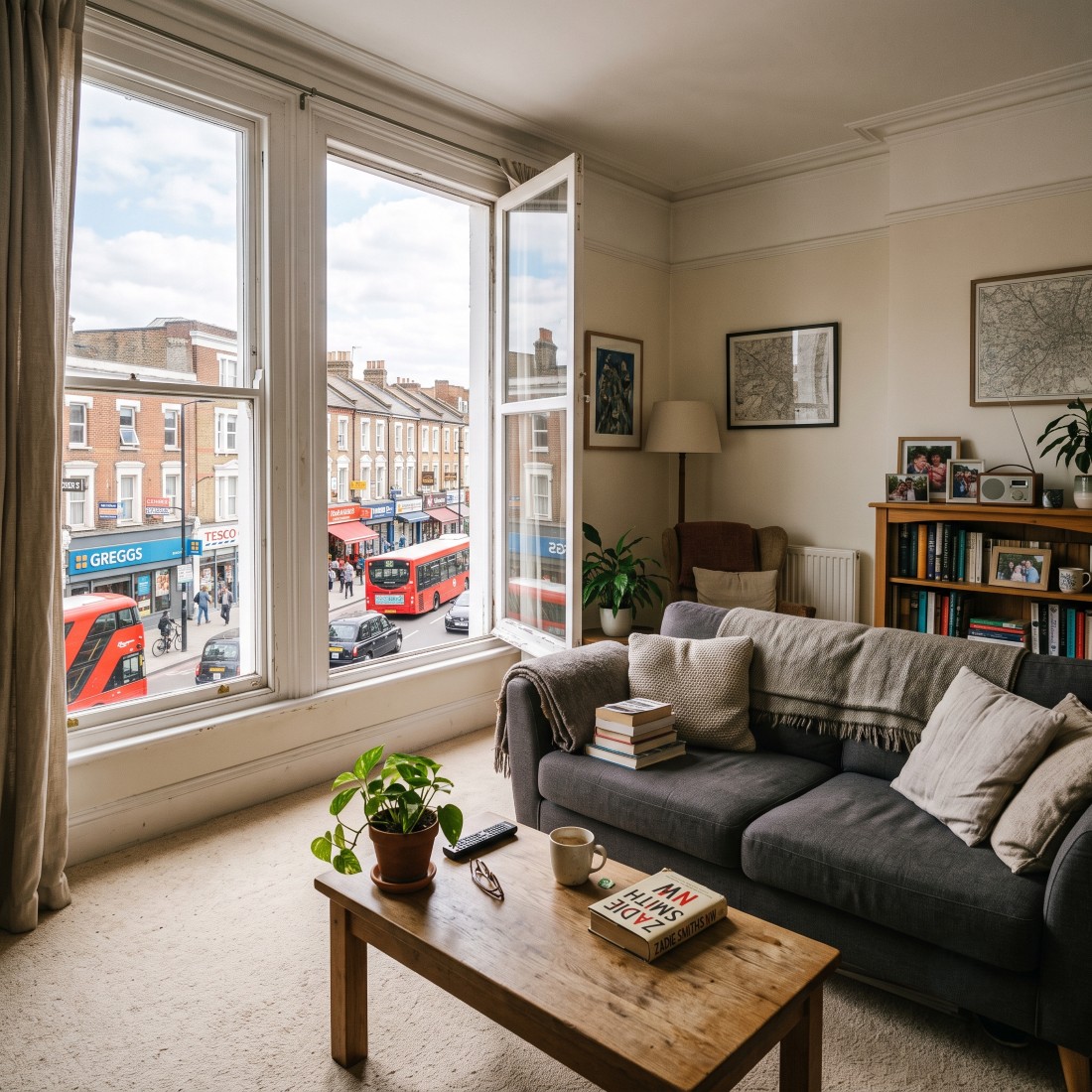
Not the front ones.
That is the honest answer and it disappoints people, because every leaflet and every well-meaning relative says the same thing: get the windows open, get the air moving, get it dry. The advice is sound in a cul-de-sac in Ruislip. On the Holloway Road at half past five it hands you a carpet that dries an hour quicker and looks worse in March than it did in January. You are trading moisture for particulate, and the particulate stays.
Does opening a window make a carpet dry faster?
Yes, when the air outside is drier than the air inside. Not otherwise.
Drying is a moisture-gradient problem. Water leaves the pile when the air immediately above it can hold more than it currently does, and the number that governs that is the absolute moisture content of the air, in grams per cubic metre, rather than the humidity percentage on somebody’s phone. Those two get confused constantly and the confusion costs people whole afternoons.
The bit about outdoor air that gets ignored
A February morning at 12°C and 90% humidity sounds hopeless. Bring that air into a room at 20°C and it lands somewhere near 55% – it warms, its capacity roughly doubles, and it will pull moisture out of a wool pile at a decent rate. Cold damp air is a good drying tool once it is indoors and warm.
July is the reverse. Muggy air at 20°C and 80% coming into a room at 21°C does almost nothing, because there is no temperature lift to create the gap. Open windows in a humid August week are theatre. I have stood in a flat in Tooting with every sash up, a client convinced she was helping, and a hygrometer showing the room wetter than the street.
What is coming through that window on a main road?
Everything the road makes, which is more than exhaust.
Brake dust and tyre wear now account for the larger share of traffic particulate in London, and neither is affected by what comes out of the tailpipe or by which emissions zone the street sits in. Every set of lights, every bus stop, every pedestrian crossing is a place where vehicles slow and shed metal and rubber. Mid-block on a straight road is measurably cleaner than the fifteen metres either side of a junction. If your front window faces a bus stop you are living downwind of a machine that manufactures fine black dust on a timetable.
Why a damp pile is a better filter than a dry one
Here is the part that matters and the part nobody explains.
A dry carpet is a mediocre dust trap. Particles land on the tips of the fibres, sit there loosely, and a vacuum takes most of them away next Tuesday. A damp carpet is a different object. Moisture on the fibre surface captures fine particulate on contact and holds it against the removal you would otherwise get, and as the pile dries those particles are drawn down into the yarn rather than left on top of it. You have effectively run the room’s air through a wet filter for six hours and then let the filter set.
On a light wool twist the result shows up as a general dulling that the client notices about two months later and blames on the clean. It is one of the most common complaints in this trade and one of the least well diagnosed. Go and look at where the window sits relative to the worst patch. Nine times out of ten the greying runs in a rough fan from the sash, widest at the sill, fading towards the middle of the room.
Cream and pale grey carpets show it in weeks. A mid-brown Berber can absorb a year of it before anyone says anything, which is less an argument for brown carpet than an observation about what people can see.
The fibre matters as well. Wool holds moisture in the core of the yarn and stays measurably damp for hours after the surface feels dry to a hand, so the window during which it behaves as a filter is long. Polypropylene gives up its water quickly and sits at the other end of the scale. Anyone with wool on a red route is running the longest exposure with the most absorbent material, which is the combination I would least want.
Why do you get grey lines along the skirting boards?
Because air is being pulled through the carpet, and the carpet is doing the job of a filter that nobody installed.
Filtration soiling is the trade name for it and it is the clearest evidence I can point at when a client wants to argue about ventilation. Air moves from higher pressure to lower pressure, and in a flat that means from the room towards gaps in the structure – under the skirting, at the edge of a floorboard, beneath a closed door. The air carries fine particulate. The gap is too small to let the particulate through cleanly, so the last few millimetres of carpet at the edge of the room catch it. Over a couple of years you get a dark line, sharply defined, following the skirting exactly.
The door threshold tells you more than the middle of the room
Go and look at the underside of a bedroom door in a flat on a bus route. There will be a band on the carpet where the door closes, darker than everything either side of it, straight-edged. That soiling arrived airborne. No shoe made it.
The reason this belongs in a conversation about windows is that opening one changes the pressure balance in the whole flat and increases the volume of air being dragged across those edges. Do that while the carpet is damp and holding onto everything it touches, and you have arranged the worst possible version of the process. I have watched it produce a visible line in a single season.
Off the Holloway Road last year, a first-floor conversion with a hall and three bedrooms in a pale wool. The client had booked me because the hall was going grey at the edges and she thought the previous firm had left residue in it. There was no residue. There was a sash window over a bus stop that she had been opening after every clean for eleven years, on advice, with the 43 and the 271 pulling away from the kerb underneath it. I got most of it out with a solvent-side prespray and a lot of patience. The line came back within eighteen months because nothing about the flat had changed.
When should you open the windows, and which ones?
Rear elevation, always, if you have one. Street side, rarely.
Most London conversions and terraces have something at the back – a garden, a lightwell, a yard, another building’s blank wall. The air there is dirty too. It is dirty in a different way from the road, and the difference between a rear window and a front window on a main road is larger than most people would guess. Open the back, close the front, and put a fan in the doorway to move air through the flat in that direction.
Traffic peaks and the hours worth using
The kerbside particulate curve follows the traffic. Two peaks, roughly seven to ten and four to seven, with the evening one usually worse because the road surface has been drying and lifting all day. Between eleven and three you have a window that is meaningfully cleaner than rush hour, and if you are going to open a front sash at all, that is when.
Here is where I part company with most of the trade: the standard instruction to throw every window open after a clean is wrong on any London A-road, and the people repeating it have never gone back to the same flat six months later to look at the skirting. Slower drying behind closed front windows beats faster drying with the A503 blowing through the room. Nine hours and clean beats five hours and grey.
What works better than an open window?
Move the air indoors and take the moisture out of it. Swapping the whole room’s air with the street is the part to avoid.
A dehumidifier in a closed room is the strongest tool available for this. It drops the moisture content of the air the carpet is drying into without importing anything, and the water ends up in a tank you pour down the sink. Pair it with one air mover aimed low across the pile at a shallow angle and you will match open-window drying times in most rooms, sometimes better.
Wiring, noise and the limits of the thing
Old flats push back. A conversion running one ring main will trip if you put a dehumidifier and two air movers on it, and the fuse board is often somewhere inconvenient. Air movers are loud enough that nobody will tolerate them overnight in a bedroom, so the sequence is usually aggressive airflow for three or four hours while somebody is in, then the dehumidifier alone with the doors shut.
Trickle vents in the window frames stay open regardless. They are small enough not to change the arithmetic and closing them causes condensation problems that are worse than the dust.
Extractor fans are worth switching on and nobody thinks of them. A bathroom fan running with the bathroom door open pulls air out of the flat and creates a small negative pressure, which draws replacement air in through whichever opening you have chosen rather than through every gap at once. It gives you a crude directional control over where the incoming air comes from. On a flat where the only openable window faces the road, that fan is doing more for the carpet than the window is.
One more thing on the Wandsworth one-way system, where I did a ground-floor flat in the spring: the client had a hedge across the front of the house, mature and thick, and the carpet by that window was noticeably better than the one by the bare window at the side. Vegetation between a room and a road is worth something. Not a solution. Worth something.
Go and look at your own skirting boards in daylight, along the wall nearest the street.
Editorial flags
- The claim that brake and tyre wear now exceed exhaust emissions as a source of traffic particulate in London is well supported but check current DEFRA or Imperial College London figures before publication if you want to add numbers.
- Traffic peak timings are indicative and vary by corridor.
- Bus route numbers (43, 271) are correct for the Holloway Road at time of writing – verify before publication.